Date: January 2026
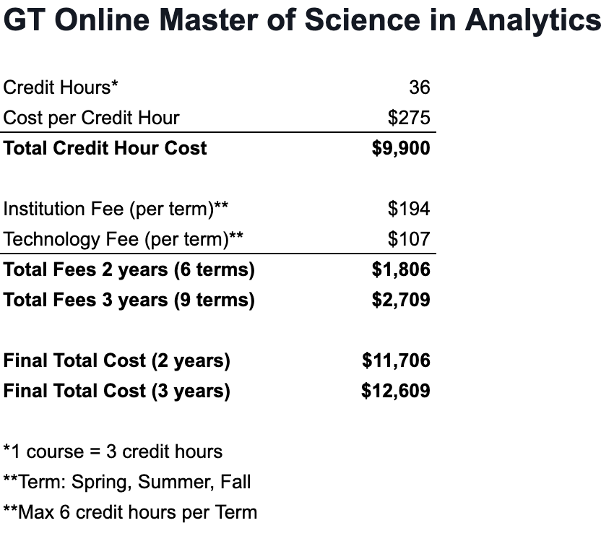
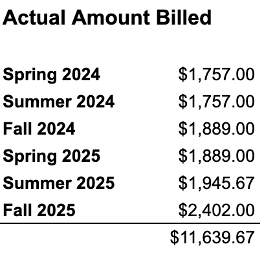
Back in December 2023, I wrote about the factors that led me to pursue graduate education and my decision to enroll in Georgia Tech’s Online Master of Science in Analytics (OMSA). At the time, I viewed it as a calculated investment in my future which aligned with my career aspirations and provided me flexibility at an affordable price (thanks element22 for sponsoring me!). See below for both the expect and billed amounts.When I started the Georgia Tech Online Master of Science in Analytics (OMSA), I wasn’t looking for a credential to hang on a wall. I wanted something practical, structured, and rigorous enough to sharpen how I think about data, how I build models, how I question assumptions, and how I translate technical work into business outcomes.
Now, having completed the program in the shortest possible timeframe of two years, I want to circle back and share the reality of that investment. If you are a business-minded professional looking to pivot into the technical weeds, or a consultant wondering if you can balance this with a full-time career, here is my retrospective on the journey.
1. The Perspective: A Business Background in a Technical World
One of the most common questions I saw online was regarding the prerequisite technical knowledge. I did my undergrad in Finance and Strategy Consulting, and I currently work as a Data Consultant, my goal wasn’t necessarily to make a career shift into data science or machine learning, but rather to master key introductory concepts that bridge the gap between business strategy and key data concepts.
The OMSA program is interdisciplinary, and coming from a business background, I found that I had a distinct advantage in the management and strategy courses, while I had to work significantly harder in the computational and simulation courses. Having some coding experience going into the program is highly advised especially for course such as Introduction for Computing for Data Analytics (CSE 6040) and Data and Visual Analytics (CSE 6242).
2. The Timeline: The Reality of the “Two-Year Sprint”
I personally completed the degree in two years. This is generally considered the fastest track for this specific program. To achieve this, I took two classes every single semester (including summers) while working full-time.
While this allowed me to finish quickly, I need to offer a candid warning: this schedule left me with virtually no work-life balance.

For two years, my evenings and weekends were not my own; they consisted almost exclusively of homework, lectures, and studying for exams. If you are working full-time and value your free time, mental health, or social life, I strongly advise looking at your life and obligations either to family, friends, and yourself. The sprint is possible, but the burnout risk is real.
3. Strategic Advice for Future Students
If you decide to take the plunge, you cannot go in blind. The difference between a manageable semester and a nightmare semester often comes down to course selection. Here are the tools and strategies I used to survive:

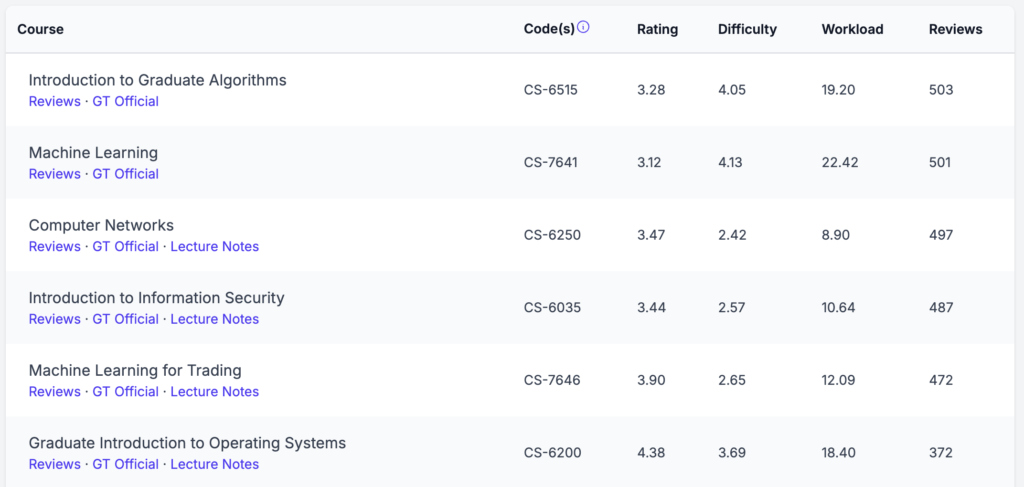
Data-Driven Decisions: Just as you would in your job, use data to plan your degree. I relied heavily on OMSCentral for student reviews and difficulty ratings. Additionally, I used Georgia Tech’s Lite Grade Distribution tool to see the statistics around grade distributions for specific classes.
Understand Your Strengths and Grading Structures: Not all courses are created equal, and neither are their grading schemes. Some classes are heavily project-based, requiring consistent weekly coding assignments and/or group work, while another is almost entirely based-on a handful of proctored exams. If you are a strong test-taker but short on time, exam-based courses might be easier to manage. If you have test anxiety but are willing to grind out code on the weekends, look for project-heavy courses. Crucially, check the syllabus before registering.
The “One Easy and One Hard” Strategy: If you must take two courses at once, (try to) avoid pairing two “heavy” courses together. My rule of thumb was to pair one difficult class (rated 3+ difficulty on OMSCentral) with one easier or business-focused class. Again “difficulty” is subjective, my experience is that the more technical courses are more “difficult” but for you that may not be the case.
Know Your Limits: As mentioned earlier, if you have a demanding full-time job, there is no shame in taking one course at a time. It is a marathon, not a sprint.
Conclusion: Was it Worth It?
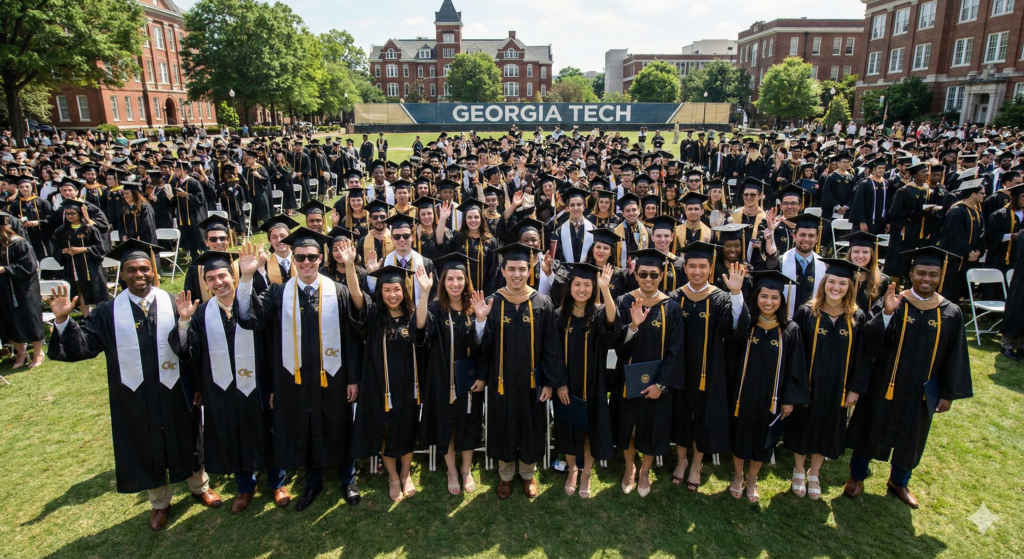
Two years ago, I asked if graduate school was a thoughtful investment or a waste of time. Looking back, Georgia Tech’s OMSA was undeniably a thoughtful investment. (We will see if it converts monetarily or career wise in the next year or so) It challenged me to grow technically, enhanced my capabilities as a Data Consultant, and provided me with a credential from a top-tier university. If you are on the fence, do your research, plan your schedule carefully, and be prepared to put in the work.